
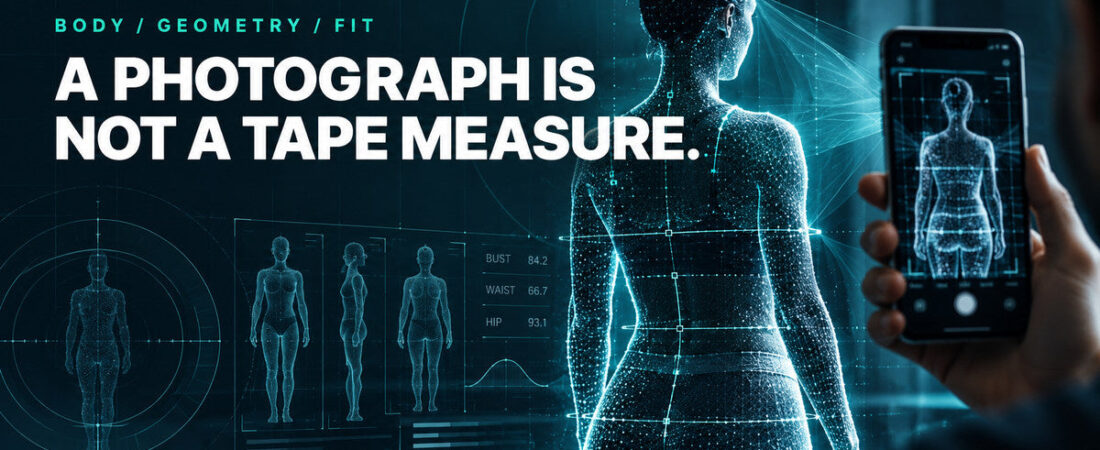

Can a Phone Camera Measure Your Body? The Science and Limits of Digital Fit
TailorScan Research Journal / Fit Intelligence
What smartphone scanning can reveal about body measurements, and where the evidence stops short of tailoring guarantees.
October 18, 2026 · TailorScan Research
A smartphone can recognize body shape from an image, but recognizing a silhouette is not the same as obtaining the measurements a tailor needs. Garments fit around a three-dimensional person who moves, breathes and has preferences about comfort and style. Turning photographs into dependable clothing decisions requires a chain of separate tests.
Computer vision and photogrammetry can make body measurement more accessible. That does not establish accurate made-to-measure fit from one casual photograph. A commercially credible fit tool must separate observed dimensions, model-estimated values, uncertainty and the physical measurements of the specific garment.
What a September 2026 study actually found
In a peer-reviewed study published September 28, 2026 in Sensors, Ruting Cheng and colleagues tested smartphone-based PolyCam photogrammetry against the Fit3D ProScanner. The research analyzed scans of 144 pregnant participants over time, extracting circumferences at four anatomical locations. Average biases were below 16 millimeters, intraclass correlation coefficients were above 0.8 and the two methods captured comparable changes in body shape.
A separate rigid-mannequin test found mean measurement biases below 3.5 millimeters compared with reference tape measurements. That controlled result cannot simply be applied to moving human subjects. The researchers explicitly identified a need for independent-scale and direct human measurement validation before wider applications.
Why that matters: the paper validates a multi-view 3D capture workflow for specific body measurements and longitudinal comparisons. It does not validate a single-photo clothing-fit service or prove how accurately a sewing pattern will fit a customer.
The three missing pieces in a selfie
Perspective, camera lens, distance and posture distort apparent lengths. An image alone may not supply a trustworthy physical scale.
Loose clothes, arms, hair and occluded body surfaces hide reference points. A model can infer geometry, but an inference is not a direct measurement.
Fabric stretch, seam allowances, lining, intended ease, design and customer preference all influence fit beyond body dimensions.
Guided front, side and additional views can improve information coverage. Scale references and depth sensors may help, depending on the capture protocol and the supported hardware. Each added requirement is also a product-design cost: extra instructions, more failed captures and more sensitive images to protect.
The difference between a body profile and a fit decision
ISO 8559-1:2017, reviewed and confirmed in 2026, provides anthropometric definitions for clothing sizing and measurement. It helps standardize what a dimension means, not how every brand should cut a specific shirt or how close a customer prefers it to fit.
| Customer objective | Evidence the workflow needs | Output that can be defended |
|---|---|---|
| Choose a retail size | Body measurements, actual brand sizing, fabric properties, fit preference | Suggested sizes with disclosed uncertainty and return options |
| Alter an existing garment | Body profile plus garment dimensions and construction constraints | Alteration questions for a qualified tailor, not a guaranteed cutting instruction |
| Buy secondhand | Seller’s laid-flat measurements, condition and stretch | Compatibility range with missing measurements clearly flagged |
| Order a custom garment | Repeatable verified measurement protocol, physical pattern and ease requirements | Reviewable measurement sheet with mandatory confirmations |
A credible photo-to-fit workflow
- Capture screening. Explain supported devices and poses. Reject blurred, occluded, poorly lit or out-of-spec images rather than producing fabricated precision.
- Measurement provenance. Mark every value as manual, reference-verified or model-estimated. Preserve units, date, capture method and corrections.
- Uncertainty thresholds. Do not hide a weak estimate under a confident-looking decimal. Route uncertain cases to manual checks or a professional tailor.
- Independent validation. Compare against trained manual measurements for human participants, report error distributions for each dimension and measure repeatability across phones and capture conditions.
- Garment-level trials. Test whether the resulting recommendation actually improves size choice, alterations or returns against a defined baseline, rather than evaluating mesh reconstruction alone.
- Privacy controls. Make image retention, export, deletion and any third-party processing understandable before upload. Provide consent and security controls that match the actual implementation.
Privacy belongs in the product specification
Body images and derived measurements can be sensitive. The Federal Trade Commission’s biometric-information policy statement warns that misleading accuracy claims, unexpected collection and insufficient review of third-party processing can harm consumers. Which privacy and biometric laws apply depends on how a real application identifies people, handles data and where it operates. That requires qualified legal and security review before launch.
Better product defaults include minimum necessary image collection, encryption, documented processor access, limited retention and accessible deletion. “Private” and “processed on device” must describe implemented, tested behavior, not marketing language. An attractive body-rendering demo is not evidence that these safeguards exist.
Consumer caution: do not make irreversible garment alterations or cut costly fabric based only on a prototype-estimated measurement. Have consequential dimensions confirmed by a qualified professional.
What TailorSnap should prove before commercialization
A research direction for TailorScan’s TailorSnap concept is a measurement-informed apparel workflow that can support thrift buying, alterations, manufacturer specifications and custom fit. The first viable release should not promise “perfect fit from one photo.” It should prove a narrower, repeatable customer outcome with a real test population and garment data.
Useful product metrics include capture completion rate on actual customer phones, per-measurement error and confidence, correction frequency, size-selection improvement, successful tailor handoffs and a customer-friendly delete/export process. Every metric should come from testing, not a vendor’s promotional screenshot. Revenue, user adoption and customer satisfaction remain unverified until independently measured.
Explore the research program
TailorScan studies practical technology ventures, including Fit Intelligence. Apparel, tailoring and responsible test collaborators can use the company contact channel to discuss specific applications or validation protocols.
This article is research commentary, not an offer of a validated scanning or tailoring service. No fit accuracy or commercial readiness is guaranteed.
The better benchmark
By 2027, the important question will not be whether a model can create a plausible avatar. It will be whether the system helps someone choose, alter or manufacture a garment with fewer errors and fewer disclosures hidden in the fine print. A verified modest improvement is worth more than a beautiful measurement animation of unknown accuracy.
- Cheng et al., Sensors 2026, 26(19), 6143: photogrammetry validated against a commercial scanner under described research conditions.
- ISO 8559-1:2017: definitions and measurement foundations for clothing sizing.
- U.S. Federal Trade Commission: biometrics risk and misleading-claims policy statement (May 2023).
Reviewed October 18, 2026. Study findings are specific to the methods and populations studied. Business opportunities described here are hypotheses, not validated or launched products. Editorial policy and disclosures ↗.