
TailorScan Research Journal / Future Commerce
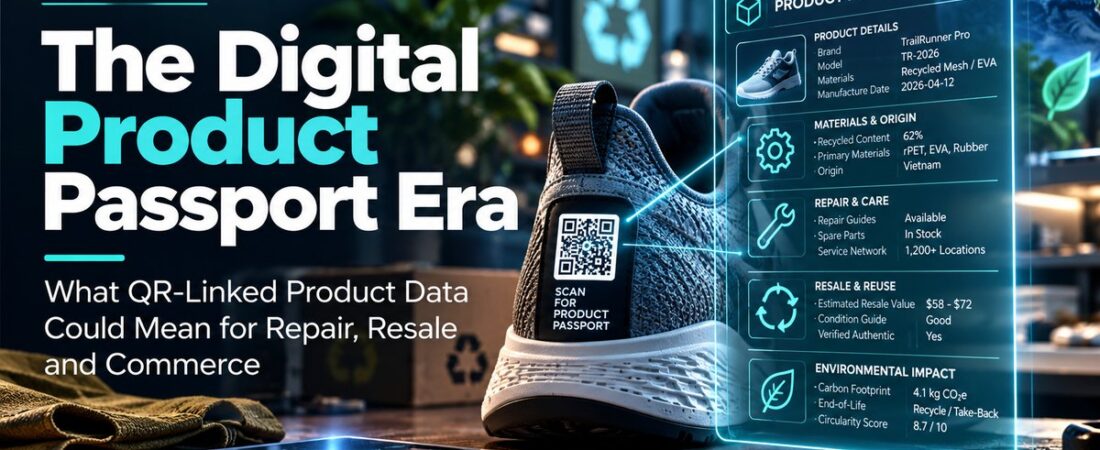
The Digital Product Passport Era
Repair, resale, and the next commerce layer
Tomorrow’s durable product may carry more than a brand name and serial number. A QR-linked information record could help owners verify specifications, find repair instructions, track service events and assess resale suitability. European product-passport rules are pushing parts of that information infrastructure toward reality, creating an opportunity for useful software before broad adoption arrives.
The promising business is not a decorative QR-code generator. It is a maintained, trusted product-information record with version history, source provenance, carefully scoped access and links to real repair or resale services.
What Europe has actually required
The EU’s Batteries Regulation, Article 77, calls for an electronic battery passport starting February 18, 2027 for electric-vehicle batteries, batteries for light means of transport, and industrial batteries over 2 kWh placed on the market or put into service. The legal text distinguishes public information from information available only to authorities or parties with a legitimate interest. This is not an immediate universal requirement for every consumer product. [1]
The European Commission describes a wider Digital Product Passport (DPP) framework under the Ecodesign for Sustainable Products Regulation. Product-specific requirements, content and binding dates depend on sectoral legislation and delegated acts. Its working-plan timetable points toward sectors including textiles, tyres, aluminium, furniture and electronics at different stages. Planned dates to develop rules should not be mistaken for universal compliance deadlines. [2,3]
The official DPP approach aims to make product information accessible through a data carrier such as a QR code. It raises new questions about identity, interoperability, trustworthy claims and who gets access to which facts. [2]
From static label to useful digital service layer
Connect a persistent product, batch or item identifier to accurate manufacturer-authorized data.
Record service instructions, spare-part eligibility, version changes and verified repair history where permitted.
Make suitable information discoverable for buyers, repair professionals, recyclers and resale partners.
GS1 Digital Link defines ways to represent GS1 identification keys inside web URIs so products can point to online information and services. That is relevant infrastructure to study, but simply creating a normal QR URL does not make a product compliant with DPP legislation or conformant to GS1. [4]
What belongs in a trustworthy record?
| Information layer | Example fields | Verification and access rule |
|---|---|---|
| Identity | Maker, model, SKU, batch, product identifier | Source: authorized manufacturer or documented owner |
| Composition | Materials, care requirements, declared percentages | Never invent test results or ecological ratings |
| Repair | Manual version, replaceable parts, service providers | Clearly identify the responsible source and current applicability |
| History | Maintenance events, authorized changes, warranty state | Consent, timestamp, attribution and correction process |
| Resale | Product specifications, condition notes, transferable documents | Distinguish seller statements from independently checked facts |
| Restricted data | Protected supplier records or personal data | Access by entitlement, not automatically displayed by a scan |
A high-value experiment for independent merchants
Choose a product whose owner has a reason to revisit its information: reusable equipment, a repaired appliance, a refurbished instrument, a durable garment or a serviceable machine. Make a public page that explains what the product is, what documentation is authentic and how to request support. Add private or authenticated records only if an actual need is proven.
- Days 1–3: identify. Select five representative items, their legitimate data owner, physical labels and existing online records. List what you do not know.
- Days 4–6: structure. Define IDs, data versioning, correction history, manufacturer links, repair documentation, source citations and permissions. Avoid sensitive owner data in public QR URLs.
- Days 7–10: test. Validate phone scans, broken links, archived versions, claims accuracy and accessibility. Include what happens if the label is damaged or the website disappears.
- Days 11–14: commercial test. Ask a repairer, secondhand seller or brand operator whether the record would save time or reduce uncertainty. Collect objections; do not fabricate conversion or resale improvements.
Four commercial models worth validating
- Manufacturer onboarding: charge for clean, source-verified product records, data import and revisions for a defined catalog.
- Repair information hub: provide instruction lookup, replacement-part referrals and service-provider discovery with disclosed referral compensation where approved.
- Resale intelligence: give sellers an evidence-based condition report template or provenance record. Charge for work actually performed, not assumed value uplift.
- White-label passport pages: host branded records and maintenance histories for small equipment or durable-goods providers, with pricing based on actual storage, support and data governance costs.
TailorScan could test a Product Record & Repair Passport prototype as a simple responsive web app: structured forms, versioned public records, QR links, document attachments, opt-in service contacts and optional merchant analytics. A future compliance-grade solution would require a separate specification; this proposal makes no claim to supply one.
Interested in a QR-linked product record pilot?
We are assessing demand for straightforward manufacturer-controlled data pages and repair or resale records. The first engagement would validate information sources, scan experience and support needs before proposing any paid subscription.
Discuss a product-data pilot ↗Merchant infrastructure, separately: A conventional storefront can sell products alongside an informational product-record system, but a store platform alone does not confer EU Digital Product Passport compliance. Explore Shopify’s merchant platform (affiliate link) if multi-channel commerce capabilities fit your actual needs.
Commercial disclosure: TailorScan owns the proposed product-record pilot and is an approved Shopify affiliate. A qualifying paid plan purchased through the linked referral may generate a commission. Shopify is an optional commerce provider, not a DPP certification. No product-passport pilot revenue or compliance outcome has been verified.
The long-term platform question
Product records become useful when they stay accurate after the initial sale. Who updates a manual after a revised component ships? Who confirms a repair? Which information survives a brand closure? Can a consumer export the data? These mundane governance questions create more enduring technical value than a QR graphic alone. For TailorScan, the research supports a small product pilot, not a leap into regulated certification.
- Regulation (EU) 2023/1542, Article 77 (battery passport requirement from February 18, 2027 for specified batteries).
- European Commission, Digital Product Passport policy and rollout (official implementation overview).
- European Commission, Digital Product Passport FAQ (scope, staged delegated acts and exclusions).
- GS1 Digital Link, technical standards and URI syntax (digital identifiers and linked information).
Published October 17, 2026. Figures and data on the editorial illustration are hypothetical visual elements, not claims about any real product. TailorScan’s software and revenue proposals are hypotheses; this article is not regulatory compliance advice. Editorial standards and corrections.